 Air Quality Portal
Prescribed fire season in North Carolina typically runs from late winter through early spring when trees and other vegetation are dormant. The season often peaks in February and March, but it can continue into the summer and intensify again later in the fall. This February has been designated as Prescribed Fire Awareness Month, so we felt it was a good time to highlight this land management practice as it relates to air quality and wildfire prevention.
Prescribed burns are “intentionally ignited and professionally controlled low-intensity fires that are used for a number of habitat improvement purposes.”1 There is a ton of information out there listing the benefits of controlled burning, a practice that’s been used for centuries. A big one is that it reduces the amount of fuel (leaves, shrubs, other woody debris) available for wildfires to consume, which makes prescribed burning a critical tool in reducing the likelihood of large, intense wildfires.
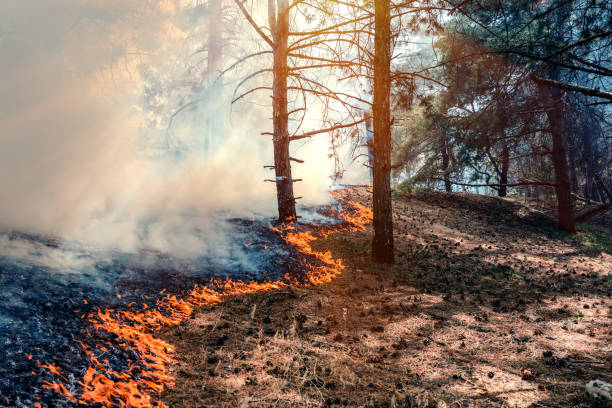
These “good fires” do still produce smoke though, and so below we’ll discuss how this practice can affect air quality and the challenges it can pose to us as air quality forecasters.
How We Rank
A lot of prescribed burning is done in our region. According to the latest National Prescribed Fire Use Report, the southeast region leads the nation in acres treated by prescribed fire annually. Burns are conducted by several entities across North Carolina, including the NC Forest Service, NC Wildlife Resources Commission, NC Division of Parks & Recreation, The Nature Conservancy, National Park Service, military installations and others including private landowners.
North Carolina stands out even amongst the southeast region – we have more acres of land at the wildland-urban interface, or WUI, than any other state in the country. The WUI is “the area where structures and other human development meet or intermingle with undeveloped wildland, forest or vegetative fuels.”2 WUI fires are especially hazardous to human life and property because of that proximity and the burning of manmade materials which can increase the toxicity of emissions. So the idea is that burning smaller, controlled fires at natural frequencies decreases the chances of unplanned, fast-growing wildfires that could cross the WUI – like what happened in Los Angeles last January. This type of mitigation for catastrophic wildfires has become a priority for the Environmental Protection Agency (EPA).
Smoke Impacts on Air Quality
Controlled burns should be conducted when atmospheric conditions are such that smoke impacts to surrounding communities will be minimized. Many burners follow the North Carolina Smoke Management Program, a certified document that gives some liability relief to those who follow it. Burners are also encouraged to follow Best Smoke Management Practices. These smoke management documents would also be used by the North Carolina Division of Air Quality (NC DAQ) in any future exceptional event demonstrations related to prescribed fire and so are a crucial part of maintaining the fine particulate (PM2.5) NAAQS.
We often see localized PM2.5 levels spike for a few hours when burners are actively firing, but widespread air quality impacts from a single prescribed fire are usually minimal. Bigger air quality issues can (and do) arise when multiple entities and private landowners throughout the southeast region burn at the same time and overload the airshed with smoke. When the weather conditions are right everyone wants to burn, and some recent research suggests those ideal days may become less common. More burning on fewer acceptable days could lead to an overburdened airshed and more issues with the daily PM2.5 standard in the future.

These ‘everyone burns’ days are very challenging for us as forecasters. Even if we’re aware of the bigger North Carolina burns happening on a particular day, we don’t necessarily know what’s going to happen in South Carolina, Georgia, Alabama, or Florida. And often it isn’t one single day but multiple days in a row that gradually degrade the airshed as it stagnates. If winds turn southwesterly, then all that smoke drifts towards us and can mix down to the surface. Another tricky scenario we’ve encountered is when conditions are good for burning on a particular day, but temperature inversions or light winds the following day(s) trap the smoke in the airshed and lead to higher than expected fine particulate levels downstream.

As forecasters, we have to assess data from multiple online sources to make decisions during prescribed burning season. Our greatest challenge is to proactively and accurately forecast air quality for those days when prescribed burning activity is high, while avoiding reactive forecast updates on the day of; we want the public to be able to plan for impacts ahead of time. Continually improving our information sharing and communication with land management professionals is the best way we can address this challenge.
Smoke is Smoke – DAQ Will Alert You
Prescribed burning ideally should happen at a frequency that mimics an area’s natural fire cycle. We know that land managers currently need to be burning more to meet this frequency and want to increase prescribed burning in the near future in order to accomplish their goals. At the same time, fine particulate standards continue to lower, with the EPA having tightened the primary annual PM2.5 standard in February of 2024. Balancing these different environmental goals will be a continual challenge for all involved.
NC DAQ supports prescribed burning and recognizes how important this land management practice is for wildfire prevention. But at the end of the day, our job as forecasters is to protect public health in terms of air quality and we will continue to do that to the best of our ability. There may be days when one or more prescribed burns warrant an air quality action day, and we will continue to monitor for and issue those alerts when needed.
Additional Information
You can get the daily air quality forecast for your specific county on the main page of the Division of Air Quality’s Air Quality Portal. Also linked on that page is our daily forecast discussion, where we explain in more detail how the forecast was determined. Additional resources and information about smoke, wildfires, and prescribed burns can be found on NC DAQ’s website.
- https://ncwf.org/blog/prescribed-fire/#:~:text=Late%20winter%20and%20spring%2C%20typically,brainer%20for%20wildlife%20and%20habitat ↩︎
- https://www.ncagr.gov/divisions/nc-forest-service/fire-control-and-prevention/wui#:~:text=The%20wildland%20urban%20interface%20(WUI,increases%20this%20acreage%20every%20year ↩︎